I love books. I love books about people, about changing experiences, and about people from all across the world. Reading a particularly short story about world travel in English Class today, reminded me of how much I love Children's Ethnic Literature. Ethnic I guess can mean a multitude of things. Chinese, Hispanic, Black, Indian, Arab, Pacific Americans and more. However, the interesting thing about this genre, is the mixing flavors of voice and style. Just take a look at a few of these excerpts:
"For woman is yin, the darkness within, where untempered passions lie. And man is yang, bright truth lighting our minds." - Amy Tan, The Joy Luck Club, Ch. 4
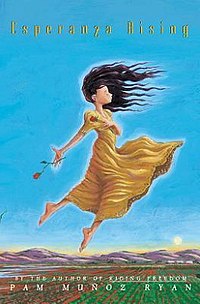
“We are like the phoenix," said Abuelita. "Rising again, with a new life ahead of us.”
I love the traditions of old generations past, the tones of ancestors, and the interesting facets of one's ancestral ethnic culture that play a part in the American Dream. That's why I really love this genre. It makes being American so flavorful, all-encompassing, and new in constantly changing experiences. Future Plans? I may take some college courses on Latino Studies, Asian America Lit, Black Diaspora, etc. (you name it!:)). The more classes and experiences I get to have in this genre, the more tastes I'll get of the melting pot! And oh, just one more proposal. How cool would it be to take a shot at creating some of my own. Maybe integrating an Ethnic Short Story into a project for Film Class? I'm sure It'll be a challenge, but I think it might be an interesting/supercoolandfun idea. Tell me what you guys think. Any ideas??
Hi Readers! This is my new Independent Video Project on what it is like to live in Silver Spring. It combines two of the main things I love about Silver Spring, Maryland: the murals and multicultural diversity. I highlighted my favorite pieces of public art displays in the downtown area. I hope the British kids coming to visit CAP enjoy it, as well as Blair Students. We often take for granted a simple piece of sculpture or painting as we pass by, but taking a closer look helped me to TRULY to appreciate the hidden layer of intense history and stories! I hope you guys enjoy this tour through Downtown as much as I did!
(This was shot using an iPad 2)
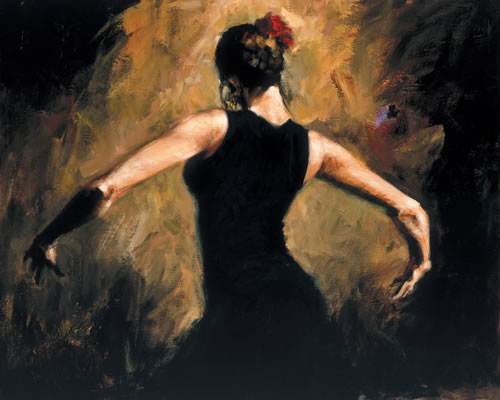
Flamenco. Not a lot of people know exactly what it is, more or less, have an interest in it. To me, its an art form, a form of expressing ones feeling, in either dance, music, or any form of movement. It can be broad or narrow, and interpreted in so many ways.
A traditional dance and music style originating from Andalusia, Spain, Flamenco is a tantalizing melting pot of arab, gypsy, and spanish art. The tocaor (guitar player) accompanies the bailaor (dancer) and cantaor (singer). To me the mixture of these three artists, along with a clapping rhythm allow for the most simple yet versatile mode of expression. Anger, love, jealousy, glee, and despair are just some of the multitude of feelings expressed in this art form.
Of my favorite beats/rhythms of flamenco is the traditional buleria. This slow, and passionate style is very raspy and mystic sounding to me (a facet I love). Here is one of my favorite examples, featuring the renowned Estrella Morente and one of the three flamenco dynasties: Los Habichuelas.
Flamenco can be a single art form, or a musical festivity enjoyed by many. One of the three flamenco dynasties is called La Ketama. Here is one of their popular DVD albums. I love how its so improvisational and family-oriented.
Finally, flamenco is slowly evolving with tastes from other nations and Spain's youth. Here are two examples. One is a collaboration with more modern artists: Nina Pastori and Raul Rojas. The other is a flamenco rendition of a famous Turkish folk song.
This post was almost like poetry for me. It helped me put out my true feelings for this art form, and I enjoyed sharing some of my favorites with you:)
The documentary, National
Geographic: Science of Babies is an observational piece that examines
the complex and dynamic subtleties of baby development during the first 12
months. This eye-opening documentary is literally
set in stage at the beginning. The
picture opens with a curtain rising revealing the minute and seemingly normal
activities of a baby, playing on an empty theater stage. From this “center stage,” the narrator pulls
the viewer into the first stage of the baby’s life, delivery. Intense B-roll footage of baby deliveries as
well as the post delivery process is shown.
However, the magic is shown in the experiments done. Revealing infant-kind’s inheritance from
evolutionary processes, the documentary unexpectedly discusses the magic of
language learning, walking, social recognition and other behavioral biology changes
a baby undergoes in just ONE year.
The
documentary’s method of storytelling is literary and dramatic, and real-time in
its cinematography. In terms of the
literary working, the concept of a baby is dramatically interpreted as a
character on stage, learning, interacting, and experiencing. One stage of the baby’s performance might be
the throwing of a ball, and this catalyzes a camera documentation of research
relating to motor skills development.
Researchers and Scientists become the center players now, portrayed
through close up shots of Computer Screens and Machinery, Medical Imaging, and
Animated shots of orbiting neurons of Baby’s inside world. In addition to the more literal cinematography,
the baby’s point of view is also figuratively established to give an insider
view on how a baby actually develops.
This is done through clever camera tilts and jerks give the sense of how
a baby walks at first.
Although, I
loved the artistic and visual aspect of this documentary, the real treasure was
the breathtaking discovery and research-based knowledge! Scientists and Human Development experts from
all across the spectrum contributed their perspectives on essentially evolutionary
trends on why babies develop the way do.
Neurobiologists, Cognitive Scientists, Behavioral Specialists, and
Pediatricians, gave a variety of inputs, resulted in a diversified knowledge. For instance, when explaining why babies are
able to process words in the way they do, Computer Scientists compared their
ability to being superior to robots, while Pediatricians looked at the more
social and environmental trends that allow one to learn words. Psychologists focused on how babies loose
abilities to detect subtlety in facial expressions of primates, but inherently learn
how to do math. These ground-breaking
discoveries weren't the only impressive facets of this documentary. The social and game/play-oriented experiments
through which this research was done WAS ACTUALLY FILMED! Thus, I got not only
a literary/informational perspective of the science in general, but also was
able to see the proof and play behind it.
I highly
recommend this documentary to behavior science or biology aficionados. The facts are packed with interesting NEW AND
COMING research, as well as a plethora of scientists and well-reputable
sources. For the softhearted and baby-loving
audience, this documentary has plenty of sequences of crawling, giggling, and
happy babies, are sure to delight your guchi-goo! A unique balance of biology and babies earns this documentary
four out of five stars!
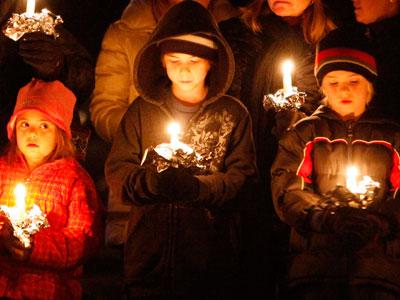
The tremendously heart-wrenching and sad massacre at Sandy Hook Elementary School, resulting in the death of 27 innocent lives, has sparked a wave of grief in the humble town of Newtown and the nation as a whole. As we heal from this tragedy, it came to my attention how beautiful and amazing the interfaith dialogue has been, in helping to alleviate the grief or at least hare it with others.
After watching CNN's broadcast of the Vigil in owner of the victims I realized many of the commonalities of the religions' messages. These messages of peace, comfort, healing through prayer, and community strength, all seemed very close to my heart. It was a joy to see how each major religion had a representative and advocate for peace from their perspectives.
In line with the Vigil at Newton were the International Conference on World Religions and Blair's creation of its very first Interfaith Club, founded by Juliette Provost. For me faith and dialogue are too methods of not only healing, but also UNDERSTANDING and AWARENESS.
Prison, to me, is not a widely explored social topic. They are places where the criminals, murderers, robbers, rapists, and fiends of society are locked away, shunned, and kept safely away from the outside world. This however, raised a question in mind. Can prison systems around the world serve has a rehabilitation effort rather then total life punishment?
In many instances, American prisoners are often wasting time in their cells, doing some service work but not learning much. In Turkey and Kuwait, torture is a huge mechanism of fear, thus instilling the concept of a punishing sentence. However, a unique, strict, yet cleverly effective system is Japan's.
In a Women's Prison near Tokugawa, discipline is taught through doing tasks, such as laundry, meditation constant cleaning, housekeeping and other sources of occupation. Creating and maintaining a disciplined lifestyle is often the key to rehab and bettering oneself in prison. I think other nations should following the Japanese Model. Rather than having prisoners waste their lives away, why not be productive and turn them into positive members of society instead of returning as what they were before.
Although a few vague ideas for the documentary project have been swirling around in my head, its time to solidify them into clear visions. Here are three.
Bilingual at Blair
Everyday at School, I notice sooo many languages being spoken. As a group of individuals we are so diverse in our speech. I want to pinpoint on both ESOL learners and students of equal fluency in two languages The Documentary will be thus two fold, uncovering the challenges of learning English as well as the ups and downs of being bilingual The project will be mainly interviewed-based, consisting of real-time footage of students Shots of classrooms, cultural shows and exchanges will also be included. The purpose is too relay the diversity and usefulness in being Bilingual.
Documenting Dance
Through both Blair dance classes and local studios, I want to document the learning of dance among teens and kids. Specific styles such as flamenco, interpretative, Chinese or Indian Classical, and Hip-hop are too be concentrated upon. The purpose is to relay the pressure, purpose, and craft of learning dance as a process and a journey in learning. Animation visuals will portray this as a road to becoming that never quite ends, but continues in fruitful quest.
Refugee
A strong number of refugees are present in the DMV area. Through interviews both far and close, the documentary will portray the story of being a refugee immigrant in the U.S. and how it differs from just normal immigration. I plan to use poetry as a catalyst for narrating the film. Historical facts about refugee history will also be given as well as everyday perspectives from refugees, teachers, policy-makers, and refugee organizations such as the Association of Bhutanese in America.